 ColmarTour
Six markets sounds like marketing. It isn't. Colmar really does set up six separate Christmas markets inside an old town you can cross in fifteen minutes, and they are not interchangeable — one sells foie gras, one is built for six-year-olds, one is indoors and full of people who make things with their hands.
Most visitors do two of them, decide the whole thing is a chalet selling the same mulled wine as everywhere else, and leave. What helps is knowing in advance what each square is for.
The Colmar Christmas market season runs 23 November to 29 December 2026, and entry is free — you pay for what you eat, drink and carry home. If you want the stories behind the buildings the chalets are standing in front of, our self-guided audio walk covers 27 stops through the same streets for €9.99, and it runs offline, so you are not depending on mobile data in a December crowd.
Still planning the whole trip? Start with our complete guide to Colmar, then come back here for the market details.
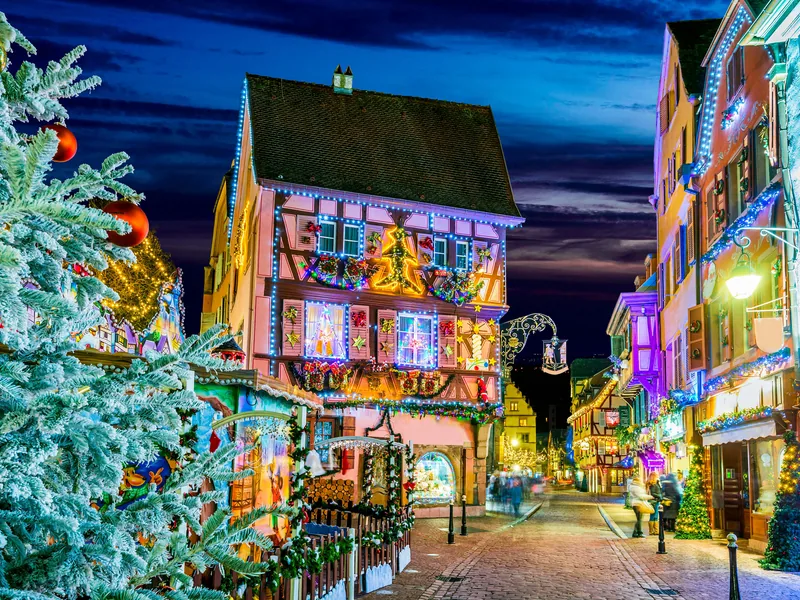
At a glance
| Dates 2026 | 23 November – 29 December |
|---|---|
| Gourmet market & Ferris wheel | 23 November 2026 – 3 January 2027 |
| Cost of entry | Free, all six |
| Hours Mon–Thu | 11:00–19:00 |
| Hours Fri–Sun | 10:00–20:00 |
| 24 December | 11:00–17:00 |
| 25–26 December | 10:00–20:00 |
| How long you need | Half a day for all six on foot |
| Old town by car | Closed to traffic during market hours |
| From Paris | ~2h20, TGV from Gare de l'Est |
| From Strasbourg | ~30 minutes by train |
The six markets, one by one
All six sit close together — usually a few minutes on foot between neighbouring squares. Here is what each one is for.
1. Place des Dominicains — the big one
Around sixty chalets under the wall of a 14th-century Dominican church, lit from below. This is the market that ends up on the postcards and in everyone's camera roll.
What's on sale: Christmas decorations, ornaments, gift-ish objects. Quality is mixed — there is genuine Alsatian glasswork and there is also the kind of thing you find at every European market from Vienna to Lille. Look at the stall, not the setting.
The lighting is what makes this square work, so come after dark. At 11am you are looking at wooden huts in a car-free square.
2. Place de l'Ancienne Douane — the one around the fountain
About fifty chalets arranged around the Schwendi fountain, with the Koïfhus behind them. The mix here leans a little more contemporary than Dominicains: modern makers alongside the traditional decorations.
This square is also the natural pause. There are benches, there is space, and the building behind you is the one where the Décapole — the league of ten free Alsatian towns — used to meet, and where goods were taxed.
3. Place Jeanne d'Arc — the food and wine one
If you want to take something edible home from Colmar, start here. The square is dressed as a small Alsatian village and the stalls are regional producers: foie gras, charcuterie, Alsace wines, eaux-de-vie, and the Christmas baking — bredele, pain d'épices, kougelhopf.
It is also the most useful square for anyone shopping rather than sightseeing: you are buying from the people who made the thing.
4. Place des Six Montagnes Noires — the children's market
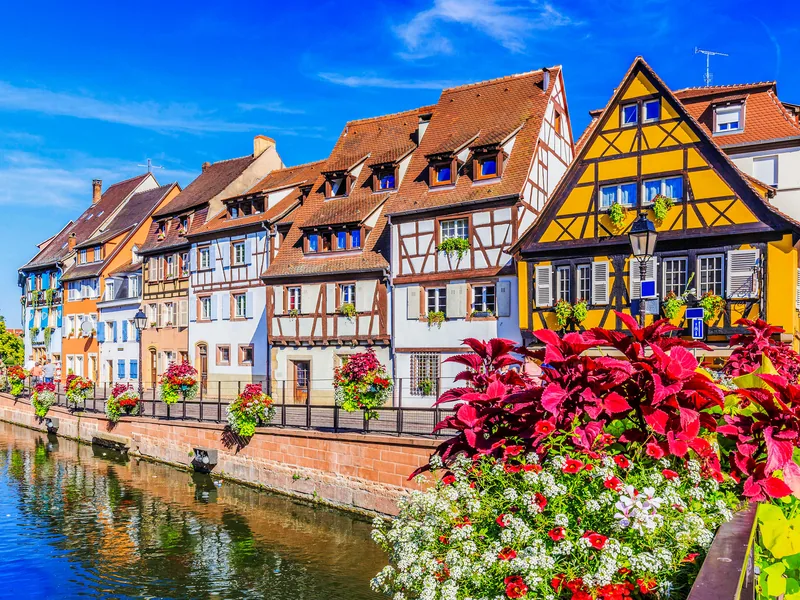
Down in La Petite Venise, and built entirely around families. Live animals, a mechanical nativity scene, carousel horses, a giant letterbox for Santa, and hot apple juice for anyone who is not drinking the wine.
Without children you can skip this one — almost everything here is aimed at families. With children it is the opposite: save it for the moment everyone has had enough of chalets.
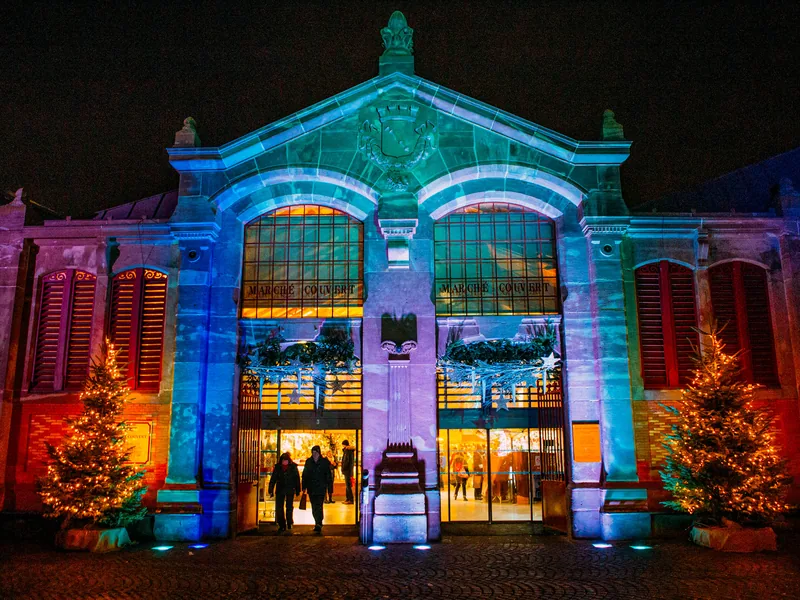
5. Marché Intérieur du Koïfhus — the indoor one
Inside the Koïfhus itself, and easy to miss, because from outside it does not look like a market at all.
It is the craft market: ceramicists, potters, glassmakers, woodcarvers, hat makers, jewellers. Real workshops, often with the maker behind the table. It is also warm, dry and quiet, which on a wet December afternoon is worth something on its own.
This is the one to go to when your hands stop working and you have stopped enjoying yourself. Twenty minutes inside resets the day.
6. Marché Gourmand — the eating one
Set up on the Rue de la Montagne Verte, and it runs on a different calendar from the other five: 23 November to 3 January, daily 11:00–22:00, closing at 17:00 on 31 December.
Nine chalets, nine chefs, cooking from starters to desserts, with cooking demonstrations in the early evening on selected dates. This is dinner, not a snack between stalls — and because it runs into January, it is the answer to "we came between Christmas and New Year and everything is shut."
The six at a glance
| Market | Where | What it's for | Best time |
|---|---|---|---|
| Place des Dominicains | Dominican church square | Decorations, gifts, ~60 chalets | After dark |
| Place de l'Ancienne Douane | Schwendi fountain / Koïfhus | Modern + traditional, ~50 chalets | Late afternoon |
| Place Jeanne d'Arc | Alsatian village setting | Food, wine, eaux-de-vie | Any time; buy here |
| Place des Six Montagnes Noires | La Petite Venise | Children, animals, nativity | Daytime, with kids |
| Marché Intérieur du Koïfhus | Inside the Koïfhus | Craft workshops, indoors | When it rains |
| Marché Gourmand | Rue de la Montagne Verte | Hot food, sit-down dinner, to 3 Jan | Evening, hungry |
Which Colmar Christmas market is worth your time
If you have two hours: Jeanne d'Arc for something to bring home, then Dominicains after dark. That is the shortest route to the version of Colmar you came for.
If you have half a day: add the Koïfhus interior and Ancienne Douane, and finish at the Marché Gourmand for dinner.
If you have children: reverse it. Start at Six Montagnes Noires in daylight while everyone is still cheerful, then work back up through the old town as the lights come on.
If you have been before: look into the covered Koïfhus market — it is the easiest of the six to walk past on a first visit.
Hours, crowds and when to actually go
| Monday–Thursday | 11:00–19:00 |
|---|---|
| Friday–Sunday | 10:00–20:00 |
| 24 December | 11:00–17:00 |
| 25 & 26 December | 10:00–20:00 |
| Gourmet market | Daily 11:00–22:00 (31 Dec to 17:00) |
The single decision that changes your day is weekday or weekend.
December Saturdays in Colmar are genuinely crowded — coach groups from Germany and Switzerland, day-trippers from Strasbourg, and a town centre closed to cars precisely because there are too many people in it. You will queue for vin chaud and shuffle through Dominicains.
A Tuesday or Wednesday in the same week feels quite different: the same chalets and the same lights, but noticeably fewer people.
If the weekend is your only option, arrive by 10:00 and do your buying before lunch — or come later in the evening, once some of the day groups have left. The middle of the day is the worst of it.
One more note on timing: in late November and December the illuminations come on around dusk, roughly 16:30. That means the version of Colmar you came to photograph starts mid-afternoon, and the markets stay open for three to four hours after it.
Getting there, parking and the car-free centre
The old town is closed to traffic during market hours. Plan on that rather than discovering it.
By train. Colmar sits on the Paris–Strasbourg–Basel line and the station is a ten-minute walk from the first market. From Paris the direct TGV takes about 2h20, and in December it is worth booking that one ahead. From Strasbourg the journey is about 30 minutes with regional trains running through the day; from Basel about 45 minutes.
By car. Paid car parks in the centre: Mairie, Rapp, Gare/Bleylé, St Josse and Lacarre, most open 07:00–21:00. On weekends there is a Park & Ride at the Parc des Expositions for €3, with a free shuttle in and out — that is the stress-free option on a Saturday and it costs less than the centre.
Staying over. Rooms in the old town get booked well ahead for December weekends, and prices rise noticeably. If you want to sleep in the centre, don't leave the booking late; if you are already close to the date, look at Eguisheim or Turckheim and take the train or a short drive in.
What to eat and drink
- Vin chaud — mulled wine. Try the white version: in Alsace it is far more common than at Christmas markets elsewhere.
- Bredele — small spiced Christmas biscuits, sold by weight.
- Pain d'épices — Alsatian gingerbread, dense and honeyed.
- Tarte flambée (flammekueche) — thin-crust, cream, onion, bacon. The default market dinner.
- Choucroute — if it is cold and you have walked all day.
- Kougelhopf — the ring-shaped yeast cake; the savoury bacon-and-walnut version is the one to take seriously.
- Manele — the little brioche men, a December thing, mostly for children.
If Alsatian fruit spirits interest you, Place Jeanne d'Arc is a good place to meet them at the producers' own stalls — pear, plum (quetsche), mirabelle, kirsch.
Beyond the chalets
- The illuminations. The whole old town is lit through December, and the effect is better in the narrow streets between the squares than on the big squares themselves.
- The ice rink at Place Rapp, surrounded by snow-dressed trees and chalets.
- The Ferris wheel, running on the gourmet market's calendar through to 3 January.
- Boat rides in La Petite Venise, with children's choirs singing from the boats on certain evenings.
- The Musée Unterlinden. If you want to add one museum to the markets, this is the main candidate — it holds the Isenheim Altarpiece. €14, open Wed–Mon 09:00–18:00, closed Tuesdays, last entry 17:30. In December, buy the ticket in advance.
Mistakes people make
Treating it as one market. Doing "the Colmar Christmas market" usually means doing Dominicains and leaving. That is one market out of six.
Coming on a December Saturday with no plan. It is the busiest day of the busiest month in a town built for far fewer people.
Arriving at 11:00 for the lights. The photographs that made you come here were taken after dusk.
Buying the first ornament you see. Range and prices vary from square to square, and the Koïfhus has more work by the makers themselves.
Arriving without cash. Many chalets take cards; enough don't that it will cost you a purchase.
Dressing for walking instead of standing. You will be stationary for hours in a cold, damp river town. That is a different problem from a cold walk.
Skipping the Koïfhus because it doesn't look like a market. It is the best of the six for craft, and the only one with a roof.
Planning only Colmar. Eguisheim, Riquewihr, Kaysersberg and Turckheim all run their own markets within twenty minutes, on their own dates.
The audio guide
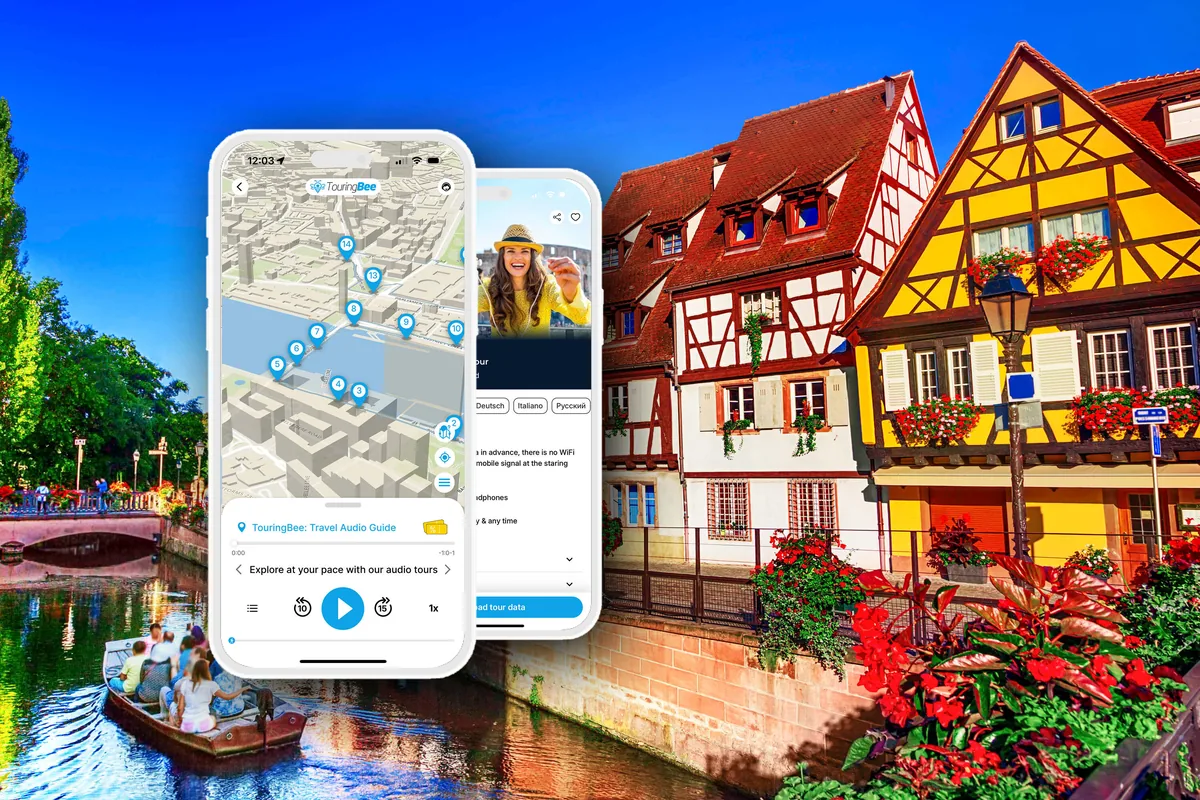
Colmar Old Town Walking Tour
€9.99 · one payment, no subscription
- 27 stops, with the route and stories prepared by professional authors
- 100% offline once downloaded — no data needed in a crowded old town
- Offline GPS map shows where you are; you start each track yourself at the stop
- English, French, German, Italian and Polish
- iOS and Android · 1 year of access
- About 1.5 hours, entirely at your own pace
The route runs through the squares the markets stand in, so in December you get both at once: why the Koïfhus mattered, who Schwendi was and what he is holding, which Colmar house is associated with the visual world of Studio Ghibli, and what the Star of David on the brewery actually means.
Frequently asked questions
When is the Colmar Christmas market in 2026?
23 November to 29 December 2026 for five of the six markets. The Marché Gourmand runs longer — 23 November to 3 January 2027.
How much does it cost to get in?
Nothing. All six markets are free to enter; you pay only for what you buy.
What are the opening hours?
Monday to Thursday 11:00–19:00, Friday to Sunday 10:00–20:00. On 24 December they close early, at 17:00, and on 25 and 26 December they run 10:00–20:00. The Marché Gourmand is open daily 11:00–22:00, closing at 17:00 on 31 December.
Is the Colmar Christmas market open on Christmas Day?
Yes. In 2026 the markets are open on 25 and 26 December, 10:00–20:00.
Which is the best Colmar Christmas market?
It depends what you want: Dominicains for the setting, Jeanne d'Arc for food and wine, the Koïfhus interior for craft. Those three are the core.
How long do I need?
Half a day covers all six on foot. A full day lets you add the Unterlinden and an unhurried dinner at the Marché Gourmand.
Can I do it as a day trip from Strasbourg?
Easily. About thirty minutes by train each way, and Colmar's markets are close enough together that an afternoon and evening is enough.
Is Colmar better than Strasbourg for Christmas markets?
Colmar is more compact: its six sites are an easy half-day on foot. Strasbourg's Christmas market is considerably larger and spread over a wider area.
Continue exploring
- The complete guide to Colmar — the pillar guide: old town, Little Venice, Unterlinden, and what a day costs.
- The 27-stop audio walk — the same squares, with the stories.
- All guides — everything published so far.
Before you go
Colmar in December is genuinely good, and it is also genuinely busy. Those two facts do not cancel out — they just mean the day rewards a little planning. Pick a weekday. Start at Jeanne d'Arc. Be at Place des Dominicains when the lights come on. Eat on the Montagne Verte. Keep the Koïfhus for the rain.
And behind the chalets stand houses several centuries old. If you want to understand what you are looking at between the mulled wine and the markets, our old-town route is 27 stops, about an hour and a half, and entirely offline.
Walk Colmar with the stories in your ear
27 stops, an hour and a half, entirely at your own pace. One payment, works offline, yours for a year.
Some links on this page are affiliate links to Tiqets, GetYourGuide, Booking.com and SNCF. If you book through them we may earn a commission at no extra cost to you. The TouringBee audio guide is our own product. See our Affiliate Disclosure.